LYRICS

The applications are to blameAll the people do all dayIs stare into a phone (Placebo, Too Many people)

“Take nothing but memories, leave nothing but footprints!” (Chief Seattle)

When rock stars were myths (Sandi Thom, I Wish I Was A Punk Rocker)

Machines were mice and men were lions once upon a time, Now that it's the opposite it's twice upon a time (Moondog)

Time is an illusion (Einstein)

Monday, 18 November 2019

Pictorial 76


I had a look at linefacedscrivener’s video on South Texas oil men, which was the world that Howard wasn’t necessarily that keen on. Oil feeds the habits of an industrial civilization lit-up by neon signs and running on superhighways.
The one thing oil wells aren’t is hygienic, which places them at the very onset of the modern era. I mean, the rough-and-ready aspect of it might not have been that unappealing to Howard. Still, at the end of the road is the modern city-based Man of neon.
The Man of neon has been, in the 21st century, basically a head that is attached to a hygiene-machine of some type. An electronic device, something that is encased in plastic or metal so that the inner works are free of air, water (as in a sterile lab, an infertile environment).
That seems to imply that, in order to thrive in the modern scene, reality is essentially hygienic, or else the semi-conductors wouldn’t be as infallible as they are.
“A vagrant charge,” said Gutierrez, “A speck of dust, a relay too worn to function right, and how could you ever know?”
“Julio,” said Erdmann. “You know better. If the slightest thing goes wrong with her she stops automatically and asks for attention.”
(The Long Tomorrow, page 188)

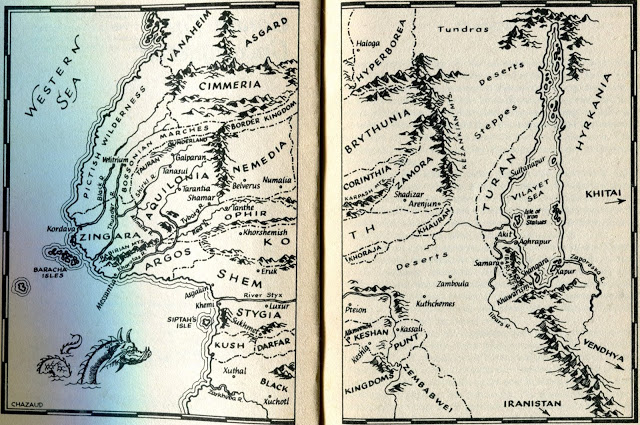
This is the “electric-green future”, symbolised by new towns like Babcock Ranch (Tales of Faith 2). What “they” call green is merely the loss of the elegant simplicity of the irregular lines of variety found on an archaic map.
Pictorial 65
An electrical future has no theme save that of straight lines, so cannot have variety. All it has is infallibility. In order to be infallible in the electronic-sphere – one needs hygiene-machines, then that reality is a hygiene reality. But –Hyborian Bridge 86- a hygiene reality tends to be mathematically observed, and is therefore not "real".
The very fact of hygiene discounts the physical reality that is bound to cycles of lifedeath, regeneration. The mathematical detail obtained is therefore a hygienic fantasy – very convincing but false.
To obtain truthful data one would have to rejoin seasonal cycles of nature. The evergreen of Gilgamesh that is frightening to the ego; the ego of acolytes of the electric arc. It’s frightening also because of its pungency. The 19th century Shanghai of pig farmers (Tales of Faith 2) is a far cry from the Shanghai of


But the old Shanghai had a decadent character, a grandeur that feeds the psyche of inhabitants great and small, of wayfarers.
Al Coutelis
Without the physical decadence that defines place (on Earth, not Mars) the sense of moral existence fades to nothing, and all one can do is shop (electronically).
The underlying reason seems to be that electronics is a copy (reflection) and not a physical reality. The physical reality is Earth, and the theme is Earth’s. The theme that emanates a psyche, powerful, subtle and cosmic.
Al Coutelis’s La Dame de Singapour
is musical, kinetic – and therefore emtional, a variation on an earthly theme of flesh, bone, stars, seas. That is romance; the geographical and oceanic reality of place on Earth. 
 
A copy or a reflection only looks realistic; there is no room for the expression of human psyche as a concomitant of the cosmos. Where there is variety and the strength of psychic existence, opne sees a sublime economy of line in the signal cultural artefacts.
This is where Weird Tales – and the covers of Margaret Brundage – takes its place amongst the singular and archaic psychic emanations of history.
It could be from Knossos (Wild Horses); 19th century Japanese prints; Isis and Osiris (Hyborian Bridge 48)..the strength of economy emanates from a place on the map of Earth, floating through the cosmos of forgotten idols. The theme that is eternal and is invisible to an electronic empire.
Granada peasant tiles (family heirloom)

Anything that is a copy (reflection) is both realistic and false! This is the confusion running round the modern globe. I did mention Hong Kong: the protests appear to be active, but there is no real rebellion, which means taking over the reins of power (bloodlessly) and pledging to uphold Basic Law.
A rebellion has consequences, or it is nothing. There’s no point bandying words (or electronic images). A rebellion is a physical act that has emotional, psychic consequences – or it is nothing , pictures on a screen.
The pictures we see from history, the covers of Weird Tales, have this physical and psychic aura that tells us they are real. They exist in the cosmos, they are not copies, they are eternal.


Saturday, 16 November 2019

Hyborian Bridge 86


I don’t know if you recall the film Royal Kill (Ninja’s Creed) from C14? It has an oddly abstract air, which probably put off reviewers. The world we live in, though, IS fantastically abstract – we don’t hunt for food, we barely see the agrarian process, we’re attached to smartphones and detached from meaningful cycles of creation and destruction (Quetzalcoatl).
An abstract world has no acquaintance with death since it is essentially just words on paper, or marks on a screen; the emanations of the mind, or AI or a combination of the two. What if that world is a fantasy, and the kinetic grace of life and death is reality?
The film appears to be a game – which is a fantasy – and yet the story and the music belong with the game and not to the bland abstraction of the city-lights and sounds.
The things which make modern life real are abstract qualities of order and predictability (straight-line progress) – the very things which in nature are unreal! The physical reality of nature is life and death, much like the game played against Nadia, the ninja assassin in the film.
This reality turns out to be a fantasy, in that Adam (the protector and good guy) and Nadia (the assassin and evil) toward the end become one entity. At that point, Morita says, “Are you ready?” and Adam returns to his life as a security guard (for Morita).
That sequence in the film is the most lurid and cheapso visual effects of all, but if one is distracted by that one may miss vital clues. For instance, his flat is nothing ordinary in that there are hanging Persian (magic) carpets. He lifts one and underneath is a tome on an 11th century hero, the figure who appeared at the start.
The entire story of the princess you can then take as an 11th century fantasy that he plays out. He also says, the worst thing in the world is “an ordinary life”. At the conclusion, another American guardian (woman) and girl appear at the park, and so there is a circular plot a la Watchmen.
The real question is: is the abstract “reality” we live in fantasy or reality? In the film, the only way Adam can escape from mundanity is to imagine a fantasy world akin to Hyboria. But if our “reality” is false or fantasy, the Hyborian-style fantasy has more music and kinetic story – which makes it emotionally real.
This is played-out in the performances, with Lalaine’s (the girl/princess) anguished “Adam!?” as his conflicting nature is revealed. Is a “reality” which is emotionally and musically insipid actually NOT reality? (I often note that contemporary pop has an almost asexual nullifier!)
The real problem is one can’t “prove” anything because at the root of things – quantum physics – things are plumb weird. All one can do is go on a hunch and follow it through. Back in Hyborian Bridge 48 I did make an analogy between a reflection in a mirror (Alice Through the Looking Glass) and Relativity. In a reflection, everything is relative to the speed of light in that what you are looking at is simply beams of light (not physical reality).
Is it fair, then, to say that a reflection in a mirror is simply the most basic example of relativity? Secondly, any razor-sharp image we see on our smartphones is a reflection; it’s not inverted – as a mirror is – but all it takes is two mirrors reflecting eachother to see an image the right way round.
So, electronic images are just electronic reflections; there’s no difference. Thirdly, electronics is the medium of mathematics; ie. all the algorithms fed into computers. Hyborian Bridge 48  quotes Einstein..
"As far as the laws of mathematics refer to reality, they are not certain, and as far as they are certain, they do not refer to reality."
..What that means is, if everything were mathematical it wouldn’t be reality (nature is not a product of reason, prev). IE mathematics is certain mathematically only.
The physical reality we live in is clearly not mathematical since it is proportionate, strong and virile, tigerish (like Nadia). The kinetic reality depicted in Royal Kill is more medieval or Hyborian than it is modern; there is dynastic loyalty and servitude, heroism.
The real point is that a pin-sharp image – whether we see it on a smartphone or via a radio-telescope – is not physical reality. It is a reflection. The black hole observed recently (Hyborian Bridge 56 Katie Bouman) was a combination of mirrors and algorithms. What “they” are observing is the universe seen through lenses – another type of mirror that reflects or refracts light.
In other words, a universe of reflections, that is relativistic, is also mathematical. Going by Einstein’s quote, that means it could be a fantasy. It’s not certain physically, only mathematically. Again, CERN is another example of a “hygiene-machine” (Pictorial 44) that sees things mathematically (only) so could be fantasy.
Whether you call it fact or mathematical data depends on your view (similarly, DNA is a one-sided view of an abstraction, rather than the life and death reality of the cosmos). Anything that is pin-sharp and super-accurate doesn’t exist in the physical sense of bone, stone, star.
When “they” say there is something called the “microcosm” (quantum physics) it cannot be seen without observing it mathematically. It’s a mathematical construct (Kari Hohne in The Mythology of Sleep says something very similar).
Therefore, then only physical world is the one that we see from the Earth, Midgard, strung midway between sun and moon. That is the unthinking world that – yes – one can apply math to, but it is far more, and introspective to the wanderer under the stars above. Unblemished by the thoughts of acolytes.

Here’e one visual example of that disparity. The mathematical world can appear very certain and resolved, like something on a microscope slide.
“where are we?” “Search me”
It’s all above board, except that it may lack the cosmic reality of the oceans and geography of the coast. What this is really getting to is that the physical world (of planets and moon and stars) allows for the moral or psyche. Starting from Newton’s experiments with refracting knives, we live in an inductive universe of experiment, and not in the physical universe that just is (C6 etc.)
The intense physicality of Weird Tales can be seen as a rebellion against the abstractions of a world built on light and electronics. A yearning for a physical sense that is not just sexual but cosmic.
The Weird Tales covers by Brundage are not merely sexy, they lust for more, they identify with idols. Idols are representations of cosmic forces and balances of Earth, man and woman.

Thursday, 14 November 2019

Hyborian Bridge 85


In the physical universe, naturalism is forever pitted against reason, for only Man has reason. Thus is the tautology born for, unless nature is a product of reason, the mind is forever circling back to its source in the straight-lines of solar light.

Leigh Brackett’s The Long Tomorrow began with this

As I’ve been saying for awhile, in classical Greece there always were two things: the city and the agrarian surround; the Apollonian temple and the unkempt Delphic Oracle seeing into uncertainty; the reasoning philosopher and the Bacchanalian followers of Dionysus, god of the vine.
In other words, our culture is not classical by any means. Nor does it have the advantages of barbarism – of freedom from cultural trappings as Howard often notes. What we have is a one-sided civilization that Francis Bacon seems to have foreseen in “The Four Idols” (Tales of Faith 10).
We are in the Idol of the Den, or the mind of the acolytes. Where Newton was a scientist-sorcerer who saw that certain things were so, his acolyte followers have us trapped in his light-box.
This is the world of the cities that is so attractive to the ego; the ego that runs like the robot on lines of steel. But the ego also runs on fear; fear of the labyrinthine ways of the forest (see Kari Hohne Gilgamesh); the forest of ragged pathways, spoor of deer, the signs that gamekeepers cherish, that the hunter chases (Tales of Faith 11)
The path joined a deer trail. Several times he bent to look at fresh signs, and when he crossed a clearing with long grass in it he could see the ground crushed in places whewre the deer had bedded. (The Long Tomorrow, page 33)
The Gilgamesh epic probably harks back to the Mesopotamia of verdant hills and luxurious hanging gardens that bore far closer resemblance to Howard’s Turan that presentday Iraq. What Kari Hohne refers to as the “Shadow Self” is the labyrinthine ways of the forest that quells the ego the the savagery of blood and revival, decay and rebirth.
Savagery is something that can be reconciled with the beliefs of Man – as in the Christendom of the Middle Ages – which is a good reason why Howard’s historical tales all come from those ages of faith and blood.  An age of faith of an age that attempts to answer what modern Man no longer even admits – the fate of the dead.
It’s no real surprise since, if we no longer live in a physical world of Earth – seasons, planets, moonrise – we can also no longer live in a psychic world (of the planets and the moon). What seems to happen in the modern world is that countries – by way of the capitalist system which is essentially abstract reason – tend to gradually lose both their physical sparkle and their psychic or moral basis.
As mentioned before, I lived in Franco’s Spain as a kid and those two things have always stayed with me (Pictorial 72.) Spain today now has a very typical split between two abstract ways of reason – ie left and right – and there is even confusion about what Spain is (Catalonia). The king did attempt to unify the country in the wake of the false referendum, and that may be their best bet.
Confusion is even more prevalent in China, where the abstract reason of the Communist Party eclipses all the traditional millennia old physical patterns of communal living in town and country. China is neither a physical nor moral country, much more like a living AI (head or electromagnetism).
The principle of Tao or the Chinese Dragon is an uncontrollable force of crazed dance that existed in all towns in the vastness of the mainland. A primeval theme that allowed for variations of story and music. The physical that allows for the moral.
Similar things are true for the cosmic being Quetzalcoatl (Hyborian Bridge 78 etc) who visits Earth at equinoxes, appearing in shadow-form at El Castillo (Chichen Itza). Earth lies suspended between sun and moon, and these cosmic serpents or dragons enact extravagant balancing acts.
DH Lawrence in The Plumed Serpent (Hyborian Bridge 82) did suggest that religions are variations of a theme, and in this case the theme has to relate to Earth being suspended between sun and moon, and that is the physical reality.
I did notice in the book that he introduces quite casually Nordic elements to Quetzalcoatl, such as the Midgard serpent, probably because he thought the religions were variations on a single mystic root (Carl Jung, natch.)
The variations of irregular patterns existing over the Earth also applies for similar reasons to Howard’s Hyborian Age. Amongst all the c ontrasting beliefs of city-states and kingdoms, it’s noticeable that the followers of Set are the only ones to attempt world domination.

Set, in Howard’s mythos, is much more akin to our modernday sorcerers of the sun – dominating the human figure to such an extent that there exist man-serpents (Conan #7) and serpent-men, such as these from Conan #89


(Conan is reciting Red Sonja’s phrase from #24)


Thoth Amon desires not only rule, but the subjugation of mankind  - not by cosmic forces, but by the snake that is forever bound to its master; the sun. Thoth Amon you could liken to a twisted sun-god, or the false Apollo that invites slime.
(ch 4)
Thoth’s ram’s horns represent the abstraction and expansion of the head over the vibrancy of the body. This is always a sign of physical weakness and the false copy that only appears true – such as the man-serpent.
The false-copy can only gain a foothold where the primeval theme of Earth’s balance has been abandoned by the sorcerers of the sun.
Where the body is a false-copy, it does not have the strength that derives from the cycle of lifedeath – the cycle that follows the seasons of the Earth. Strength is in the soil that supports plantlife that grows and decays over the seasons in a fertile cycle.
This cycle is a primitive belief that sanctifies the land and life of a tribe – see BWS Adastra in Africa (Tales of Faith 2 etc). As mentioned, the hygiene-machines of modern Man do not allow for the primitive cycles that support a tribal culture (Bill Gates’ pathogen-killing toilet Hyborian Bridge 31). The reason is that Gates and others like him have no concern with death and decay; they are only concerned with the living, and once they cease to live they have no value.
Traditional tribal cultures are the exact opposite. They revere ancestors and preserve their memory in trees and shrines and land (Adastra again). The cycle of plantlife and decayand rebirth therefore strengthens their ancestral culture and their belief.
Where the physical culture of the land and people is strong (fertile) there is much less need for advanced cures relating to people is the abstract sense. In other words, people who are strong exist on fertile land that is theirs, that they work and venerate ancestrally (belief). People who are weak don’t have that and tend to live in cities.
This is the false Apollo that invites slime, since the very fact people need treatment implies they are less well. The same applies to other things, such as hazardous sex. What the false Apollo does is consider people when they are living, but not in the cyclical sense of death and decay and revival. The false Apollo supplies treatment for people in the abstract sense, discounting the strength of primitive cycles of lifedeath.

I saw this ad which looks really great, until you realize it is a treatment for the body as a machine that lives, and is a type of weakness.
 
The false Apollo invites slime because it invites weakness; it is a snake with the head of Apollo as in Howard’s story. The head is so fantastically convincing that one doesn’t realize until too late that there is no human figure atall, and it is sliding up to you.
Conan #7


Monday, 11 November 2019

Pictorial 75


Hey, hey, hey, hey
Four winds at the four winds bar
Two doors locked and windows barred
One door let to take you in
The other one just mirrors it
Hey, hey, yeah! hey, hey
In hellish glare and inference
The other one's a duplicate
The queenly flux, eternal light
Or the light that never warms
Yes the light, that never, never warms
Never warms, never warms Astronomy Blue Oyster Cult

The one-way duplicate trap in our claustrophobic future of heads that talk like talking clocks. Out there the four winds blow – the warm, the cold, the blustery, the sheer. In here everything is bright and smooth-running, superficially sweet.

Yet, as Kari Hohne says in The Mythology of Sleep, energy can never be destroyed (in conventional physics), only converted into another form (such as mass in Einsteinian physics).

The energies of Earth, the dragons of air and water, are warming-up our dull planet, even as acolytes recite in the light of coldness. In The Long Tomorrow, warehouse boss Dulinsky is the spokesman for “America the great again”, a builder like our friend Trump

“My great-great grandfather came from Poland, and he never got rich because things were already built. But now they’re ready to be built again, and I’m going to get in on the ground floor. I know what the judge has been telling you. He’s a negativist, He’s afraid of believing in anything. I’m not. I believe in the greatness of this country, and I know that these outmoded shackles have got to be broken off if it’s ever to grow again.”

Judge Taylor, meanwhile

..gave him one burning glance and said, “A man can make anything he wants to out of words.”

The sudden violence that does erupt is sort of farcical (Dulinsky’s shooting and the “holy fire” pillaging of Refuge), but Leigh has a woman’s touch in the descriptions of land and locals.

Leigh of course is not writing of modern times, she is writing of an America that has regenerated to its barren splendour. There is a long interval whereby Len and Esau are led by barge across the mountains and plains to the hidden enclave of Bartorstown. Here’s a quote that tells of a storm.


They ducked for the shelter of the house. The wind hit first, laying the trees over and turning up the lighter sides of their leaves. Then the rain came, riding the wind in a white smother that blotted everything from sight, and it was mixed with leaves and twigs and flying branches. After that was the lightning, and the thunder, and the cracking of trees, and then after a long time only the rain was left, pouring down straight and heavy as though it was tipped out of a bucket. They went out on deck and made sure everything was fast, shivering in the new chill, and then took turns sleeping. The rain slacked and almost stopped, and then came on again with a new storm, and during his watch Len could see lightning flaring all along the horizon as the squalls danced on the forward edge of the cool air mass moving down from the north. About midnight, through diminished rain and distant thunder, Len heard a new sound, and knew that it was the river rising. (page 139)

Now, Leigh is writing a tale that is half Huckleberry Finn, and half a techno-trip – ie. the arrival at Bartorstown. The Huck Finn side of it is all sweat and toil, and the fatigue and weather roll on by.


They fed the fire while Charlie worked the draft and watched the safety valve. The thump of the piston came faster and faster, churning the paddle wheel, and the barge picked up speed, going away with the current. Finally Charlie motioned them to hold it for a while, and they stopped, leaning on their shovels and wiping the sweat off their faces. And Esau said, “I don’t think Bartorstown is going to turn out much like we thought it would.” (page 133)


They used up the coal, and took on wood at a station on the Illinois side, and beat on again to the mouth of the Missouri, and after that for days they wallowed their way up the chutes of the Big Muddy. Mostly it was hot. There were storms, and rain, and around the middle of August there came a few nights cold enough to hint of fall. Sometimes the wind blew so hard against them they had to tie up and wait, and watch the down-river traffic go past them flying. Sometimes after a rain the water would rise and run so fast that they could make no headway, and then it would fall just as quickly and show them too late how the treacherous channel had shifted, and they would have to work the barge painfully and with much labor and swearing off the sand bar where she had stuck fast. The muddy water fouled the boiler, and they had to stop and clean it, and other times they had to stop for more wood. And Esau grumbled, “This is a hell of a way for Bartorstown men to travel.” (page 139)


This struck me as an evocation of life in olden days. As in this Van Gogh


What you see is the primitive aspect of the human figure that is strong of bone and flesh; the body that warms up as it sweats, and that then goes to lie down in a shaded grove, or get anointed with oils.

The body that is mammalian, that has inbuilt thermostating in the face of variegated weather cycles. That use energises the body and gives a natural high. It is strength of bone and flesh.
When one goes into shops or public building nowadays one is hit by a wall of heat: this is for serpents; serpents we have become under the rule of heads that think and do not act.
A few hours later the wagons came in, eight of them, great lumbering things made for the hauling of freight and drawn by mules. The men who drove them were brown and leathery, with the tops of their foreheads all white when they took their hats off, and a network of pale lines around their eyes where the sun hadn’t got to the bottom of the squinted-up wrinkles. They greeted Kovacs and the bargemen as old friends, and shook Hostetter’s hand warmly as a sort of welcome-home. Then one of them, an old fellow with a piercing glance and a pair of shoulders that looked as though they could carry a wagon alone if the mules gave out, peered closely at Len and Esau and said to Hostetter, “So these are your boys.” (page 144)
Earlier, Len had asked Hostetter why he didn’t support the “Growth, progress, intelligence, future” that Dulinsky had wanted. The answer is in the remainder of the book! Actually, the “hidden in plain sight” Bartorstown reminded me of Asimov’s 2nd Foundation plot, on a more savage footing.

Yes, for Bartorstown is itself run by atom power hidden deep within a canyon. This bit of the plot didn’t exactly catch me by surprise, but the way it is worked out is intriguing.


The scientists are trapped in their belief-system, just as the outsider sects are in their sin-laden beliefs of holy fire from heaven. Then we hear about “Solution Zero”; that even Clementine – the super-computer – may not be able to tame the atom for global consumption (again).


For what is the atom but the sun? And how can one tame the sun except by its polar opposite – the moon – and the regenerative force of Artemis? Earth-power, the spin of our planet against the cosmos.


Are we moderns, then, trapped in the canyon of Bartorstown, forever using supercomputers for the global consumption of light (electronics), which is just a shadow-play of the mighty atom?


He looked at Clementine, and she was no longer sleeping. The many eyes on the panel board were bright and winking, and all through that mighty grid of wires there was a stir and a quiver, a subtle pulse of life.

The selfsame pulse, thought Len, that beats down there below. The heart and the brain. (page 217)


What Leigh is saying here is that – the two are the same. The cold light of logic – computing – and the fire of the atom. We (“they”) live in a tautology because that is what logic is (sun Apollo). It always goes back to its source, which is light (straight line), saying the same thing twice in different ways, a sort of nullification process.


The light is “cold”; it does not burn, only it burns into the brain.


The cold light molds our global thoughts into one because introspective thought depends on the unthinking cosmos (Pictorial 67). That is, the cosmos of ambiguous symmetry, balance and proportion that is observed from the parading globe.


Why should that be so? As Leigh writes in The Long Tomorrow all Man’s societies are belief systems, no less that of Bartorstown, that Clementine will solve the puzzle. There is a scene where chief physician Gutierrez is so convinced of the truth of his research that he goes mad when Clementine denies him.


“You are against me, both of you. You had it arranged between you, so that no matter what I did she would never give me the right answer…laughing because she knows the answer and won’t tell… I’ll make you tell, you bitch, you lying bitch, deceitful bitch, I’ll make you tell.” (page 219)


They believe in the sun – as do we (or “they”). The sun is an energetic source but not the heart and soul of a semi-symmetrical cosmos. This cosmos is both physical (moon, planets) and psychic (the psyche of the moon and planets – Diana, Pluto).


Man’s myths are dominated by the graceful and pleasant presence of Earth’s body in the cosmos, as part of the heavens above. The Earth’s body has unthinking power that links her to the mystery of the cosmos as a whole.


It is the unthinking power that gives pause for thought, whereas the solar-onrush of words in our present situation cancels out the very idea of introspective thinking under the stars. We are in the canyon of Bartorstown, forever searching with supercomputers for.. “Solution Zero.”


As we are all locked up here in this canyon, thought Len, serving this Moloch, this Moloch with the head of brass and the bowels of fire. (page 220)


Yes, the unthinking power of naturalism that Man – in his power of reason – destroys with straight-lines (builds over, paves over). At the finale of the book, Len and his woman, Joan, escape and hole-up in a desert town, awaiting their destiny. When Hostetter finally arrives, Preacher Man is speaking and Len is thinking


I have let it blow through me, and it is just wind. I have let the words sound in my ears, and they are nothing but words, spoken by an ignorant man with a dusty beard. They do not stir me, they do not touch me. I am done with them, too. (page 235)


The false god of ignorance speaks. But – Moloch too is false, born of the reasoning sun (light) and not of the unthinking Earth. Destiny.


Wednesday, 6 November 2019

Hyborian Bridge 84


Antiauthoritarianism (Pictorial 67) is the primitive reptilian backbone of Quetzalcoatl, god of wind and rain, harvest season, corn dolly


Earth turns her face to the cosmic symmetry that is otherwise lost to the ever-onward authority of a straight-line perspective vision. The Age of Acolytes. Words upon words to substantiate what is a parallel system – the sorcerous system of light.


The words are bolstered by egos that are fed by the perspective illusion. There is no room for doubt because doubt comes out of an “ambiguous symmetry” (CL Moore) that is the cosmos of planets and stars, sun and moon, Artemis and Apollo.


This is the lost world of the lost gods and goddesses of Earth as - in The Plumed Serpent - Christ reaches out to the Mexican Quetzalcoatl. The lost deities are agricultural and regenerative, their backbones are rooted in earth strength, introspective primitivism of wisdom.


The primitive reptilian nervous system that supports the body, that has no ego, that is indomitable. In short, the very thing of primeval strength that modern culture has not, because it is directed at the “clever” head. The “clever” ones (acolytes) are able to take what is an illusory system of perspective (light) and make of it an abstract reality – numerical, monetary.


The very abstraction bolsters the ego of the acolytes in the illusory reality; a weakness that takes no account of the primeval strength of the body in action that is the primitive spinal nervous system – bequeathed at birth.


Their god is Crom. He dwells on a great mountain. What use to call on him? Little he cares if men live or die. Better to be silent than to call his attention to you; he will send you dooms, not fortune! He is grim and loveless, but at birth he breathes power to strive and slay into a man’s soul.. (Queen of the Black Coast)


Strength that is primitive, pristine, that supports the body physically and psychically. Antiauthoritarianism is flesh, blood, bone and sudden death.


The vast power of the upper-body that drives the sword into taloned flesh, splintering bone. We are entering the labyrinth of hunter and prey of the primeval forest; the world that faces the cosmos; the world that raises fear in the ego. Fear because the ego is not part of this world; not part of a cosmos of death and rebirth. Within the warrior is the primitive reptilian force that he, by means of intelligent will, must conquer so it serves to defend the dainty and delicate with naked steel.
When the ego is free of restraint, the dragon-form of impure lusts is also free; devourer of the simple and pure. Allure is all, grace and symmetry are all, the rhythmic sense of being, the power of erotic urge and of searing vision. (Declaration)


The warrior and the hunter are instinctive forces that protect us from proselytisers of sorcerous rule, from weakness. The knight, the priest, the poet (Outremer C8 Weird 8)

What “they” give us nowadays, frankly, is “linear A”(Pictorial 8); the untranslatable language from Knossos that is a list of items in store-rooms at the palace; whereas “linear B” is the Greek of Homer’s Odyssey.

We, as heirs of mankind, are stored as inferior copies of the original – which we still are in our hearts! – because we have lost the mysterious storytelling that connects us with the primitive cosmos. It is this primitive power that Howard has, and thatWeird Tales and other pulp writers have.
So, on that note, to return to Leigh Brackett’s The Long Tomorrow.


Monday, 4 November 2019

Pictorial 74

It’s a small world out there, as the cliquishness of 30s/40s pulp writers illustrates. Starting from a WWII picture of Heinlein, de Camp and Asimov at Naval Aviation Experimental Station in Philadelphia, I discovered that Heinlein rented his house to CL Moore and her husband, Henry Kuttner.
Heinlein I know from Stranger in a Strange Land – the space-hippy epic Paul Kantner swore by - and this massive tome might be the Bible of rebellion against an authoritarian future of straight lines and cities (unbroken progress of the sorcery of light Pictorial 67).
I then happened on the post space-opera era of Leigh Brackett, especially The Long Tomorrow. It struck me that there is an optimistic and a pessimistic side to what is almost the same future of technological advance.
Brackett was married to Edmond Hamilton (of Weird Tales) who became a prolific space-opera writer and joined DC (League of Super-Heroes). The big question is if, even within spouses, future fantasy can be either optimistic or pessimistic, what does that imply? (there was actually a comic story in Metal Hurlant  to that effect by Angus Mackie!)
You’re really asking various questions, like:
What is authority?
What is existence?
What is   self, being?
But, there is a more basic question even than those; are you in favor of life or death? Clark Ashton-Smith (again of Weird Tales) could be said to have come down on the side of the latter, in stories punishing egotism in supernatural ways, and even HP Lovecraft labelled him a friend of decay.
So, what I tend to say is the optimistic version of the future doesn’t feature decay (meaning death); the pessimistic one does. Therefore, since decay does exist, the physical reality is much more on the side of pessimism.
That is to say, pessimism that says technological advance is egotism. The Long Tomorrow sets these two views squarely against each other, with “the survivors” being virtually descendants of Amish and other sects that work the earth by means of horses and have no electricity, while Bartorstown is the promised land of forbidden advance.
They were enormous wagons, with canvas tilts and all sorts of things hung to their ribs inside, so they were like dim, odorous caves on wheels.. His mind a blurred jumble of the faraway places of which the traders spoke: the little shipping settlements and fishing hamlets along the Atlantic, the lumber camps of the Appalachians, these endless New Mennonite farmlands of the Midwest, the southern hunters and hill farmers, the great rivers westward with their barges and boats, the plains beyond and the horsemen and ranches and herds of wild cattle, the lofty mountains and the land and sea still farther west.
The book gives a reasonable picture of the slow speaking, Bible fearing men of the seasons, versus the clever “others” of Bartorstown who’s siren call attracts two lads of Huck Finn persuasion (Len and Esau).
The suspicions of the Bible thumpers turn-out to be well-founded. The “slow speaking”, full-bearded men deliver savage beatings to Len and Esau prior to their elopement. In this case the cause of the fear was a nuclear war that destroyed all cities, but can one say that technological advance is a priori suspicious? Preacher Man says
“..they have loosed the sacred fire which lies at the heart of things, and which only I, the Lord Jehovah, should dare to touch.”
Is technological advance actually retrograde because it takes place outside of the physical reality that is born of Earth rhythms that regenerate life? What we call “life” is actually an inferior copy of the real thing which has a manifest destiny of physical decay and revival.
This idea of a copy or an illusion is contained in diverse technology. Not only recording (of images, sounds) but DNA is the machinery for copying lifeforms. This one-sided view (sun – Apollo “sacred fire”) doesn’t include the physical reality that in nature things are balanced, proportionate and irregular (swaying between two things, snakelike).
The serpentine backbone of things is an a priori primitivism of the universe that is what things are – their self, being. What technology does is filter-out all the sublime primitivism of power and meaning, and replace it with copies that are weak.
The underlying reason for this is that Apollo is only appearance (sun); reality is the sublime primitivism of seasons and the cycle of life and death. Dionysus, the god of gaiety and eternal frolicking in pastures green.
It was the strawberry festival, the first big social event of the summer, where people who had perhaps not seen each other since the first snow could get together and talk and pleasantly stuff themselves, sitting in the dappled sunshine under the elms.
A crowd of boys had run out along the road to meet the wagon. They were running beside it now, shouting up to Mr. Hostetter. The girls, and the boys still too little to run, stood along the edges of the square and waved and called out, the girls in their bonnets and their long skirts blowing in the warm wind, the tiny boys exactly like their fathers in homespun and broad brown hats. Then everybody began to move, flowing across the square toward the wagon, which went slower and slower and finally stopped, the six great horses tossing their heads and snorting as though they had done a mighty thing to get that wagon there and were proud of it. (ch six)

Friday, 1 November 2019

Hyborian Bridge 83


Well, I asked RT if Howard had ever crossed the border and he wasn’t sure, but said he’d written it into Savage Sword #200. I looked it up and the tale has flashfowards from a prequel to People of the Black Circle of Howard crossing the border for inspiration.

That’s all she wrote from my perspective, except that there is a very clear inspiration in Red Nails, his final story of a feuding city based largely on Aztec culture – with names like Tolkemec – as well as the labyrinth of Knossos in ancient Crete (the bull-necked prince Olmec).

I was partly asking because I realize Howard’s Conan tales have a grim, revenge-laden atmosphere, and are not “light”. If you glance at Pictorial 73 it does say that cultures that are balance between psyche and physical have a lightness that we – trapped in our heads – have lost.

I even cited the revived Aztec ball-game that has a “hippy” song-like grace of body (male and female). How can the lost, song-like lightness square with the often gloomy tone of Howard’s Conan yarns?
The Annotated Guide by Robert Weinberg is very good on that score, and he says of a quote from Queen of the Black Coast on Crom

Compare this god to the same god as written about by those authors who have continued the Conan saga. In reality, there is no comparison. The benevolent being masquerading as Crom in the de Camp-Nyberg Conan stories is not the same being that Conan speaks of here.. The Conan stories are grim, moody pieces, with a truly barbaric hero.


Weinberg also says there is no room at the inn for humour in Conan (unlike some of the other output). While there are no jokes as such, Conan does indulge in rough badinage, as in this scene from People of the Black Circle  

Buscema/Alcala art
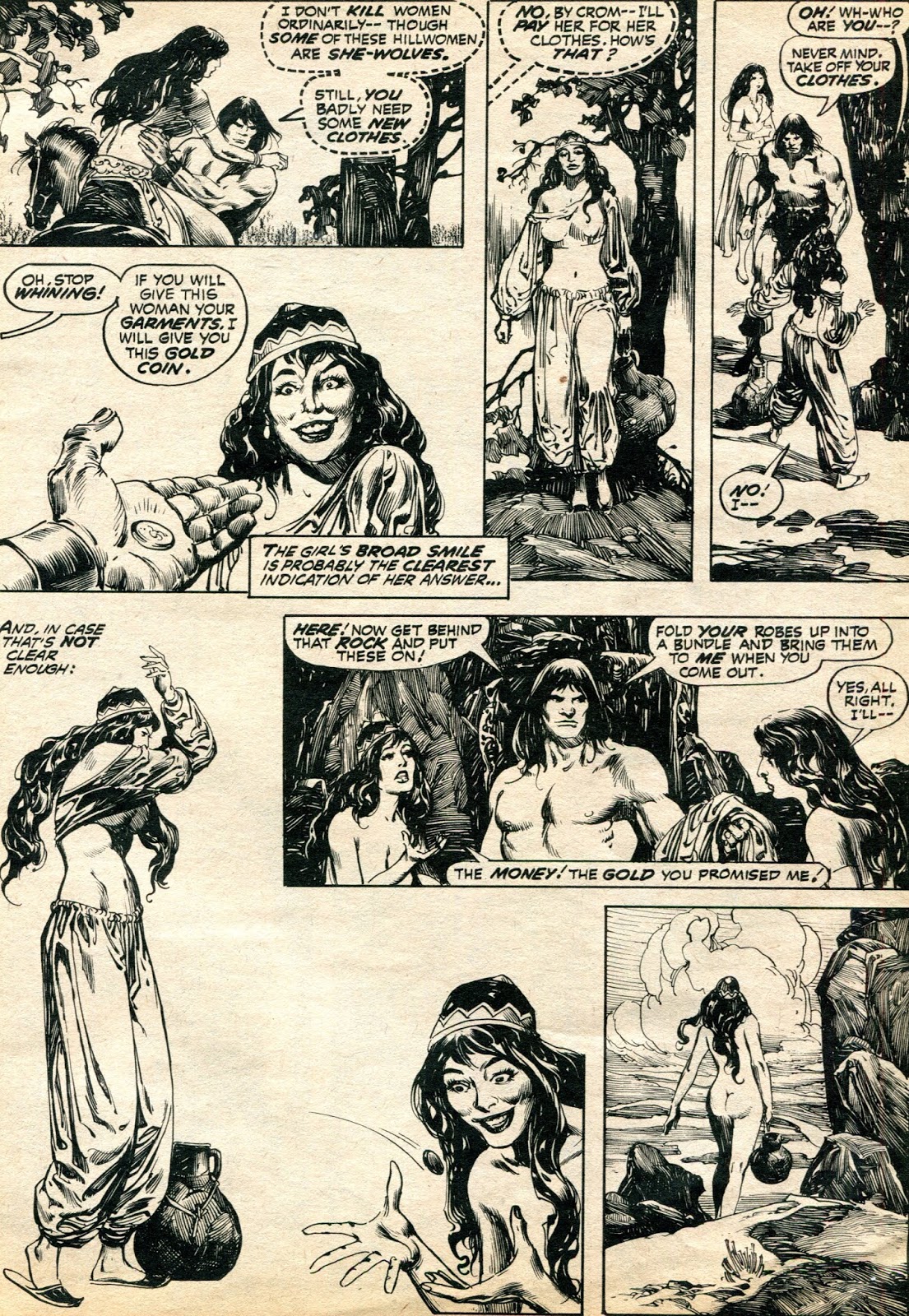
Where there is any light banter it has to fit the plot, as here in a peasant hill shack a haughty Diva is set amongst, by her barbaric abduction.
There is also in the story the physical proximity of Conan to Yasmina. It’s not high comedy but a less-than-grim irony of the sexual kind.


Savage Sword #17(c) Marvel
There is a sexual freedom of the kind that is certainly not grim. One of the most famous covers by Brundage was for Black Colossus

 
Weinberg notes this was not the case in the story, where Yasmela states

“It is not fitting that I come before the shrine clad in silk. I will go naked on my knees as befits a suppliant, lest Mitra deem I lack humility.”

“Nonsense!” Vateesa had scant respect for the ways of what she deemed a false cult. “Mitra would have folks upright before him..” Thus objurgated, Yasmela allowed the girl to garb her..

It still makes a very fitting cover, though!
Conan’s hot kisses in Hour of the Dragon to his rescuer are again a typical counter to barbaric gloom.

Conan’s love and loss of Belit in Queen of the Black Coast more than anything else casts a baleful shadow over his personality. The wild, sea-bound love, the jungle fastness that sends Belit to her death, only to conquer for an instant that ultimate abyss, while Conan has to abide in the land of the living.

There was no light in his eyes that contemplated the glassy swells. Out of the rolling blue wastes, all glory and wonder had gone.. For himself, its glittering blue splendor was more repellent than the leafy fronds..

Wild love, grim violence, the everlasting sea. Such events will touch Conan forever, their psychic luster, their physical calamity. Because Howard’s writing is so taut and poetically inspired, there is gloom aplenty. The events are grim but Conan will shake their shackles loose and roar with mirth.

The difference with the subsequent writers is they are not as wild and so neither as grim (think of The Grey God Passes for vast wildness of landscape and mindscape alike). It’s a world of extremes; of crude lusts and badinage, of godless violence in forests of the night, of moody depths.

It’s a world of psychic luster that reflects the physical. Our modern world is the exact opposite! One of mildness and verbosity in which the only grim pursuits are ball-games. I’ve nothing against ball games but they’re not life or death issues and they seem to get grimmer by the year.

Conan is honestly moody and also honestly light because he is wild and footloose and not under the rule of mildness. Is it not true that the more mild people are the more you can be sure they are running you? That is grimness with not the slightest trace of lightness.